When I started my self-improvement journey around 4 or 5 years ago, my mindset was simple: more was better.
Maximize every second of the day.
That was the goal:
- Pack my calendar airtight with no breaks.
- Blend my breakfast into a thick gray sludge so I wouldn’t “waste” time eating.
- Listen to podcasts or audiobooks at 2x speed whenever I was walking or working out.
I had goals, and I wanted to make damn sure I was winning on all fronts.
And I saw results—progress in fitness, productivity, learning—but at what cost?
I was turning into an anxious wreck, stressing over anything “non-productive.”
It wasn’t sustainable.
So, I slowed down.
I started appreciating a walk without headphones, eating a full breakfast, and having fewer daily tasks.
And something unexpected happened.
I started becoming more creative again.
Sleeping better. Feeling less anxious. I felt balanced.
Then, I started my business, and all that went out the window.
Well, not everything, but my balance was challenged immediately and immensely.
Suddenly, I was the Head of Sales, Head of Customer Service, and Head of Product Development—all rolled into one.
There was always more I could do.
Focus on one thing, and I’d fall behind on the others.
Lately, this struggle has only intensified, as the team, projects, and services have continued to expand.
And no—this is not where I tell you I’ve become some minimalist monk and encourage you to do the same.
But I will tell you that there is always more to be done.
As a solopreneur, founder, or business owner, “getting it all done” is a myth. Yet, many of us don’t know what else to aim for.
So, we end up losing the very things that got us into this line of work to begin with:
- Passion.
- Creative problem-solving.
- True idea generation.
This happened to me during my self-improvement phase, and it’s happening again now.
But the solutions? They’ve been the same each time.
Here’s how I manage to step back, reset, and avoid burnout when busyness threatens my creativity.
The myth of busyness
Modern work culture often equates busyness with success.
But this is misleading.
Being busy doesn’t mean being effective.
Busyness means tasks. Productivity means impact.
To get the best creative work, we need mental space—time for ideas to incubate, grow, and connect. And when your days are crammed with task-switching and firefighting, that space disappears.
I’ve found myself drowning in tasks, stretched across sales, strategy, and execution, and trying to do it all. It’s left me with surface-level solutions instead of innovative ideas.
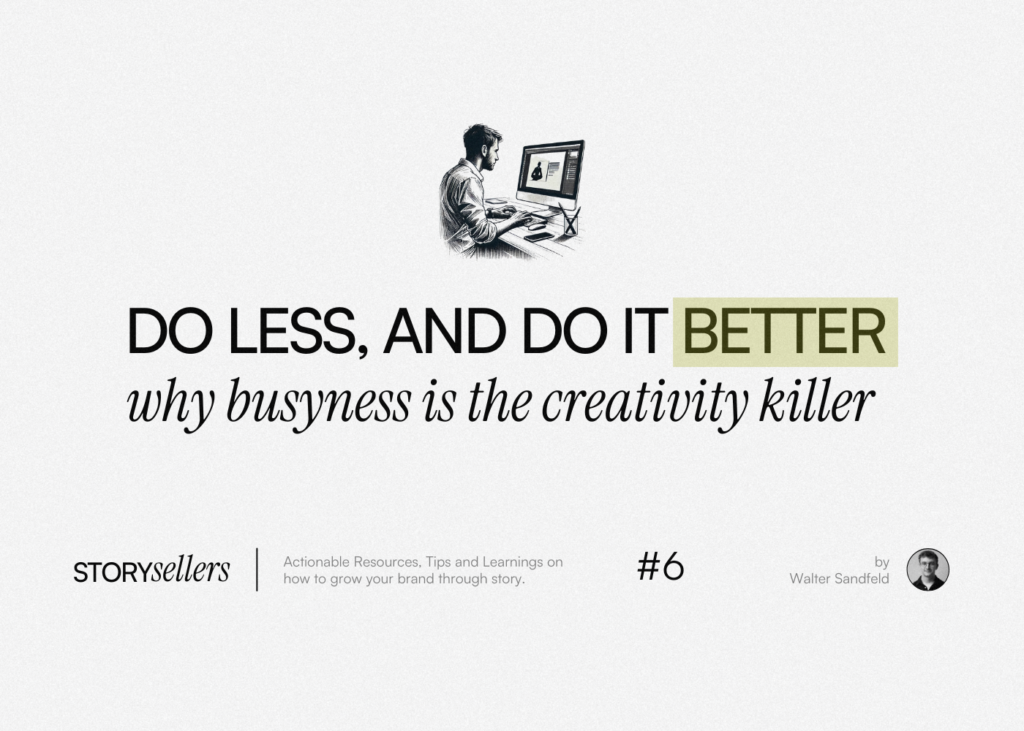
I realized that it wasn’t about doing more—it was about doing less, way better.
Inspired by Cal Newport’s “Slow Productivity,” I’ve focused on fewer tasks but with greater depth.
It’s a principle that benefits creativity: fewer, more impactful projects that receive my undivided attention.
And it’s worked. Here’s how you can apply it to your creative work too:
5 steps to embracing Slow Creativity
Slow creativity isn’t about doing nothing.
It’s about doing the right things, with the right focus, at the right time.
When you slow down and prioritize what matters, you create the conditions for deep, meaningful work.
Here are 5 steps you can use to be less busy while creating some of your best work:
1) Prioritize ruthlessly
“Deciding what not to do is as important as deciding what to do,” – Cal Newport.
Not everything you do has the same impact.
Identify the tasks that truly move the needle, and focus on them relentlessly.
Use the 80/20 Rule: apply the Pareto Principle to maximize your results with minimal effort.
Cut out low-impact activities. It’s not about doing more; it’s about doing what matters most.
2) Flow is your friend
Flow state is where your best ideas are born.
To get there, block out uninterrupted time in your schedule specifically for deep, focused work.
Protect this time fiercely—turn off notifications and minimize interruptions.
Create an environment that encourages focus. Your workspace should help you concentrate, not distract you.
Building the conditions for flow is building the conditions for creative success.
Read my article about accessing the flow state at will here.
3) Learn the true cost of commitment
New opportunities come with a price—your time and energy.
Assess each new task carefully. Does it align with your priorities and goals?
If not, let it go.
Being selective is key to staying focused. Also, communicate clearly with your team or clients about your focus areas and what you can take on.
Saying no when necessary helps you protect the space needed for what truly matters.
4) Reduce noise
Your phone holds the power of making you feel endlessly inadequate and unproductive, as you compare your output to the sum of everyone else’s.
One of the biggest productivity killers today is noise—distractions, unnecessary inputs, and comparison traps.
Recognize this for what it is—an unfair comparison.
Reduce the noise by optimizing your workflows and delegating what you can.
Leverage your team’s strengths, and keep your focus where you add the most value.
5) Rest like an artist
Rest isn’t wasted time; it’s fuel for your creativity.
Schedule regular downtime to recharge and prevent burnout. Reflect often on what’s working and what isn’t, and adjust your approach as you go.
Stop treating every moment of the day like a task that needs to be crossed off as fast as possible. Engage with what you’re doing, even when it’s rest.
Rest allows your best ideas to surface—it’s how you keep your creativity alive.
Slow creativity is about doing fewer things but doing them far better. It’s about stepping back, focusing, and giving your work—and yourself—the time it deserves.