
If you could control what people thought when they heard your name, what would you want them to think?
And more importantly, does that match what they actually think right now?
The reality is that even the most experienced, talented, and interesting people often struggle to communicate their value online, leaving their reputation underdeveloped.
We live in a Trust Drought.
People are increasingly selective with their attention, so how you’re perceived is everything.
It’s not just about how you want to be seen—it’s about aligning that with how you need to be seen to achieve your business goals.
Bridging the Perception Gap
To bridge this gap between perception and reality, start by answering these crucial questions:
1. What do I want people to think of when they hear my name?
2. What do I need them to think to reach my goals?
3. What stories, experiences, or actions can I use to align these two perspectives?
For example:
You may want to be seen as a creative thinker, but you need to be perceived as a trustworthy and reliable business operator to attract investments or clients.
Your positioning is your North Star—it’s the balance between being yourself and being the version of yourself that drives business outcomes. This is where you can control the narrative and own the first impression people have of you.
Introducing Your Unique Storytelling Proposition (USP)
That’s why building your Unique Storytelling Proposition (USP) is crucial—it allows you to shape the story people tell themselves about you, ensuring it aligns with both how you want and how you need to be perceived.
Imagine a Beam of Light.
To the naked eye, a beam of light looks the same to everyone.
But place a lens in front of it, and it refracts, creating something unique—a spectrum of colors, a focused beam, a different perspective.
Your job is to develop that lens through which your stories and information pass, making your narrative uniquely yours.
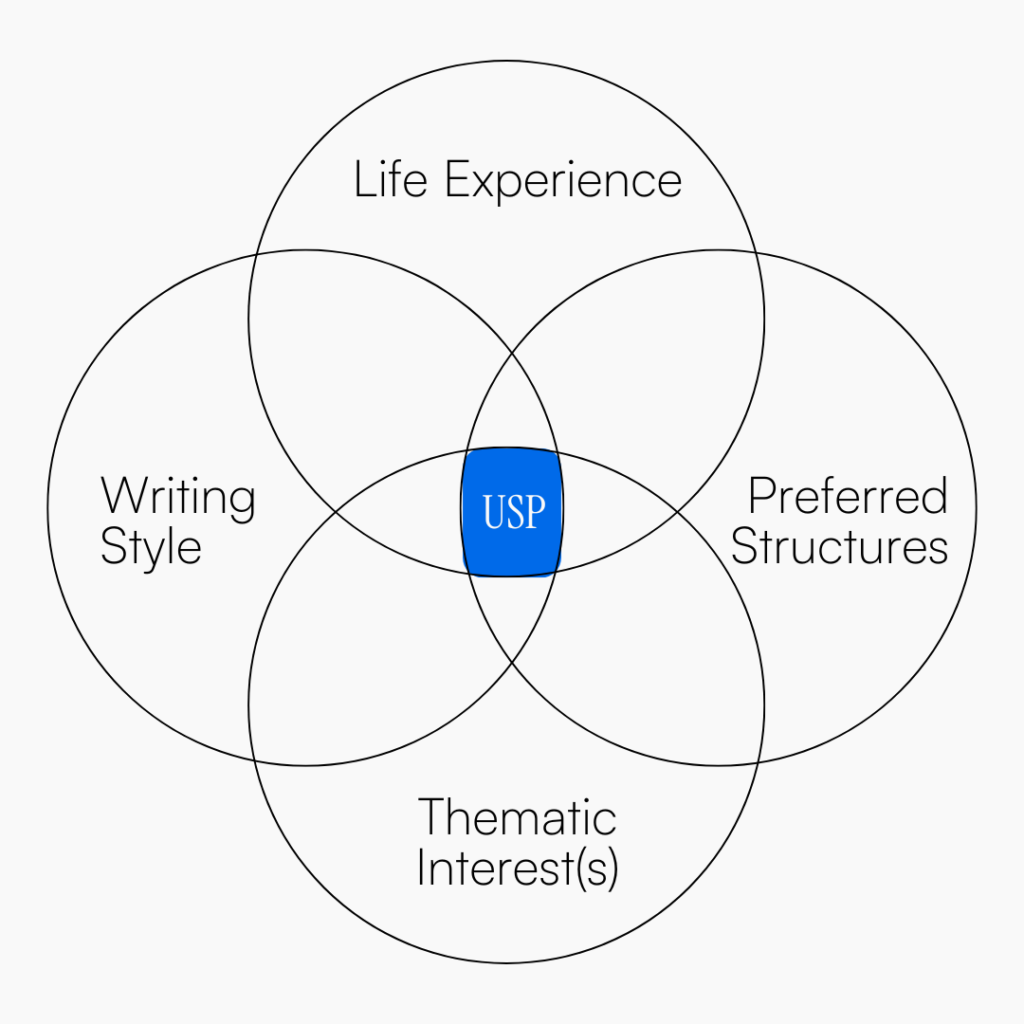
Your USP is the foundation of this lens, comprised of four key elements:
1. Life Experience
2. Writing Style
3. Preferred Structure(s)
4. Thematic Interests
Let’s explore how you can position yourself using these elements to build a personal brand that closes the gap between how you want to be seen and how you need to be seen.
1. Life Experience: Your Untapped Goldmine
Your life experience is your biggest asset. It’s what makes you relatable, credible, and unique.
Leverage Your Personal Story
The key is to use your personal story in a way that connects with your audience’s struggles or aspirations. Reflect on pivotal moments, challenges you’ve overcome, or turning points in your career.
Ask Yourself:
– What key experiences have shaped who I am today?
– What stories can I share that reflect my expertise and values?
Tip: Don’t shy away from sharing failures or setbacks—they are some of the most relatable experiences and can build trust with your audience.
2. Writing Style: Finding Your Voice
Your writing style is how you connect with your audience on a deeper level.
Develop Your Unique Voice
Whether you’re humorous, analytical, or inspirational, your voice is the vehicle of your personal brand.
Consider:
– How do you naturally express yourself?
– Are you formal or conversational?
– Do you prefer to tell stories, give direct advice, or pose questions?
Remember: Your content doesn’t have to cater to everyone—focus on speaking to those you want to attract.
3. Preferred Structure: Organizing Your Ideas
Every successful personal brand has a recognizable content structure.
Create Engaging Formats
Whether it’s lists, anecdotes, or deep-dive analyses, structure helps make your content digestible and engaging.
Reflect On:
– Do I prefer short-form or long-form content?
– What formats (e.g., how-tos, storytelling, interviews) best suit my ideas?
– What types of posts generate the most engagement for me?
Tip: Experiment with different structures to see what resonates most with your audience and refine your approach over time.
4. Thematic Interests: Aligning Topics with Audience Needs
Your thematic interests are the topics that not only interest you but also align with your audience’s pain points and desires.
Establish Your Expertise
To build authority, you need to be seen as someone who regularly speaks about specific, impactful topics.
Ask Yourself:
– What industry-specific themes do I care about?
– What problems am I helping to solve for my audience?
– How do these themes align with my overall positioning?
By consistently covering these topics, you create a coherent narrative around your brand, making it easier for people to associate you with expertise in your chosen area.
Take Control of Your Narrative
Positioning + Unique Storytelling Proposition = Personal Brand Success
By honing your life experiences, writing style, structure, and themes, you create a Unique Storytelling Proposition that positions you effectively for your audience and helps you stand out in a saturated market.
Building a successful personal brand means closing the gap between how you want to be seen and how you need to be seen.
Your USP is the framework that makes this possible, allowing you to shape your narrative and control the way people perceive you.
By developing your USP, you take control of the first impression and position yourself as the authority you’re meant to be.
Thank you for reading. If you found this newsletter valuable, feel free to share it with others who might benefit.
Until next time,